
December 3, 2025
The Markets (as of market close November 28, 2025)
November proved to be a volatile month for the stock market, ultimately concluding with slight gains for several of the major market indexes. Through the middle of the month, investors grappled with concerns about the valuation of megacap tech stocks, leading most benchmark indexes to decline for three straight weeks. However, the market staged a strong rebound late in the month leading into the Thanksgiving holiday, as more economic information became available following the reopening of the federal government. The late-month rally was largely driven by renewed hopes for a Federal Reserve interest rate cut in December. Each of the benchmark indexes ultimately ended November on an uptick, except the NASDAQ, which ended the month in the red, despite a strong rally during the last week of the month.
Market volatility was largely driven by the performance of a small number of megacap technology companies, frequently referred to as the "Magnificent Seven," due to their significant weighting in the S&P 500 and the NASDAQ, prompting their collective performance to outpace the broader market.
A major catalyst for the late-month rally was growing investor confidence in a third interest rate cut by the Federal Reserve in early December. Key federal officials have indicated that labor-market risks are a primary concern, increasing the likelihood of a rate cut. Among the market sectors, health care, communication services, energy, and consumer staples outperformed in November, while information technology, consumer discretionary, and industrials lagged.
FactSet's latest review of third quarter U.S. corporate earnings was generally favorable. Blended year-over-year earnings growth for the S&P 500 was roughly 13.4%, which marked the fourth consecutive quarter of double-digit earnings growth. In addition, 83% of S&P 500 companies reported earnings per share above estimates, well above the 10-year average of 75%.
U.S. Treasury yields in November were on a downward trend, with 10-year Treasuries falling eight basis points, and the yield on two-year Treasuries dipping about five basis points. The decline in yields, particularly the 10-year Treasury note, generally reflects investor expectations of further interest rate cuts as the Federal Reserve attempts to balance rising inflationary pressures against a softer labor market.
Crude oil prices were on track for a fourth consecutive monthly decline. A surge in global supply, particularly from non-OPEC+ producers like the United States and Brazil, has led to a steady increase in crude inventories, which has driven crude oil prices lower. The retail price of regular gasoline was $3.061 per gallon on November 24, $0.026 above the price a month earlier and $0.017 higher than the price a year ago.
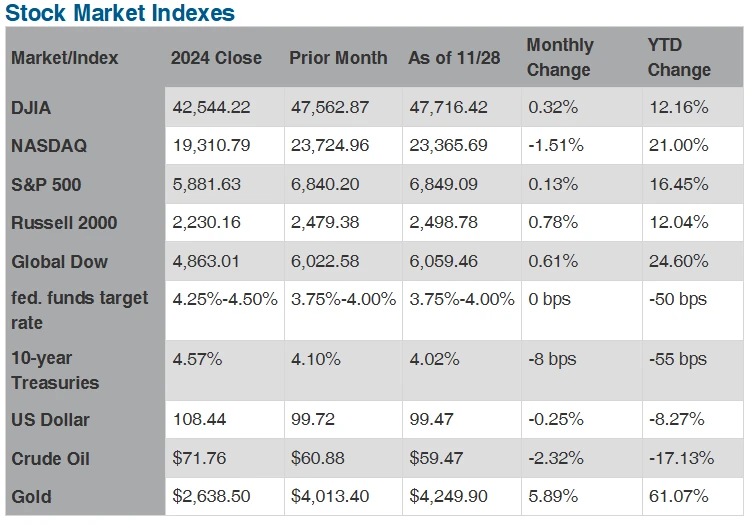
Chart reflects price changes, not total return. Because it does not include dividends or splits, it should not be used to benchmark the performance of specific investments.
Eye on the Month Ahead
Following the reopening of the federal government, the primary focus in December will center on the state of the economy and the policy of the Federal Reserve relative to interest rates.
Data sources: Economic: Based on data from U.S. Bureau of Labor Statistics (unemployment, inflation); U.S. Department of Commerce (GDP, corporate profits, retail sales, housing); S&P/Case-Shiller 20-City Composite Index (home prices); Institute for Supply Management (manufacturing/services). Performance: Based on data reported in WSJ Market Data Center (indexes); U.S. Treasury (Treasury yields); U.S. Energy Information Administration/Bloomberg.com Market Data (oil spot price, WTI, Cushing, OK); www.goldprice.org (spot gold/silver); Oanda/FX Street (currency exchange rates). News items are based on reports from multiple commonly available international news sources (i.e., wire services) and are independently verified when necessary with secondary sources such as government agencies, corporate press releases, or trade organizations. All information is based on sources deemed reliable, but no warranty or guarantee is made as to its accuracy or completeness. Neither the information nor any opinion expressed herein constitutes a solicitation for the purchase or sale of any securities, and should not be relied on as financial advice. Forecasts are based on current conditions, subject to change, and may not come to pass. U.S. Treasury securities are guaranteed by the federal government as to the timely payment of principal and interest. The principal value of Treasury securities and other bonds fluctuates with market conditions. Bonds are subject to inflation, interest-rate, and credit risks. As interest rates rise, bond prices typically fall. A bond sold or redeemed prior to maturity may be subject to loss. Past performance is no guarantee of future results. All investing involves risk, including the potential loss of principal, and there can be no guarantee that any investing strategy will be successful.
IMPORTANT DISCLOSURES Camden National Wealth Management does not provide investment, tax, legal, or retirement advice or recommendations. The information presented here is not specific to any individual's personal circumstances. To the extent that this material concerns tax matters, it is not intended or written to be used, and cannot be used, by a taxpayer for the purpose of avoiding penalties that may be imposed by law. Each taxpayer should seek independent advice from a tax professional based on his or her individual circumstances. These materials are provided for general information and educational purposes based upon publicly available information from sources believed to be reliable — we cannot assure the accuracy or completeness of these materials. The information in these materials may change at any time and without notice.
Trust and investment management services are provided by Camden National Bank, a national bank with fiduciary powers. Camden National Bank is a wholly owned subsidiary of Camden National Corporation. Camden National Bank does not provide tax, accounting or legal advice. Please consult your accountant and/or attorney for tax and legal advice.
Investment solutions such as stocks, bonds and mutual funds are:
"NOT A DEPOSIT • NOT FDIC INSURED • NOT GUARANTEED BY THE BANK • NOT INSURED BY ANY FEDERAL GOVERNMENT AGENCY • MAY LOSE VALUE"